GABA-Glutamate - A Framework for High-Gain Nervous Systems
Add a layer to your understanding of the brain and body's internal processes
Introduction
For people who are above-average sensitive to certain kinds of stimulation, gaining more control over your excitation and relaxation can be useful by diving one level deeper into the bodily processes that cause them. Mechanistic theory and tested outcomes can provide useful insights, even though the body and brain are complex systems we will never understand completely. I find it useful to introduce these concepts because they add dimensionality and levers to explain and control your excitation, relaxation, and recovery.
The aim is to look at effects, approaches and interventions and explain them from the interplay of these variables. Note that the aim of these variables is not technical perfection, but get a practical grasp and more nuanced intuition of what is going on in your body. The following example demonstrates how adding one dimension can change how you look at relaxation:
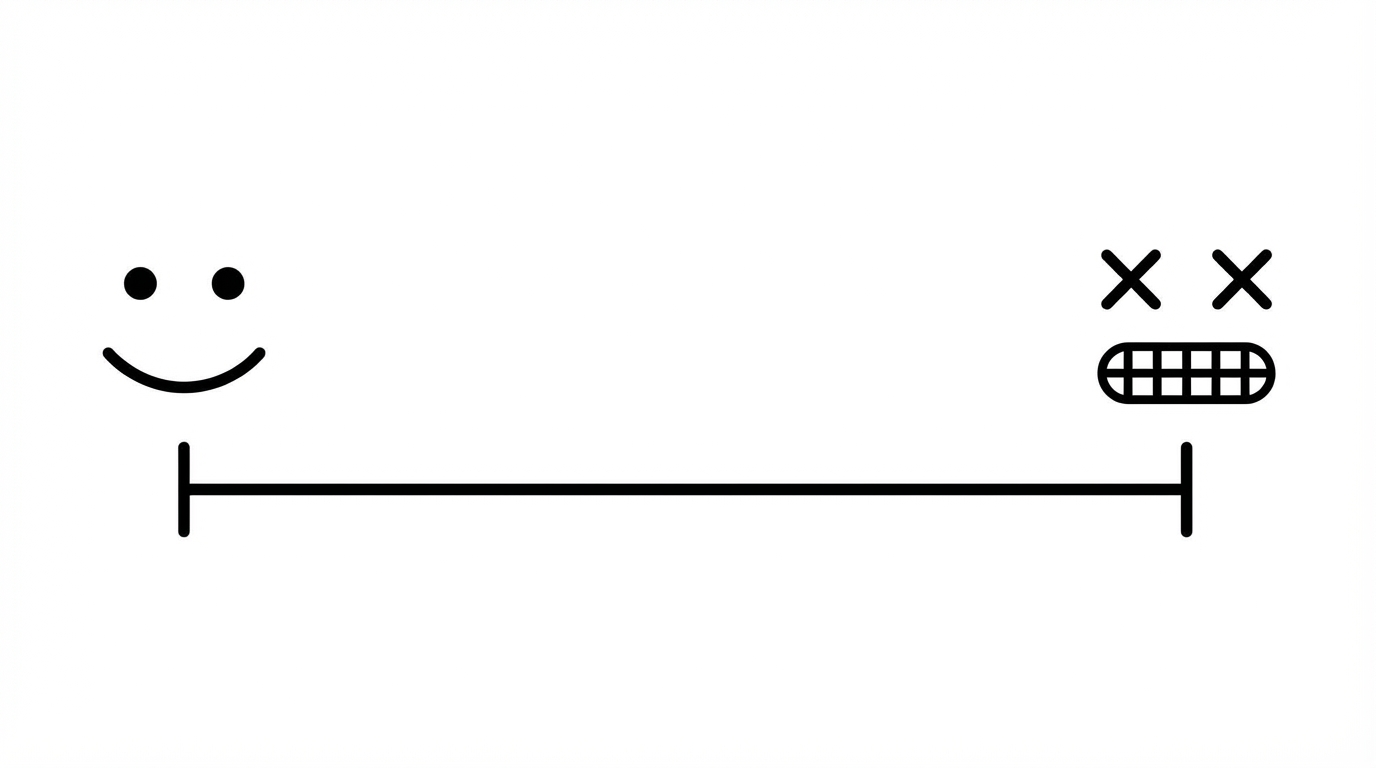
Instead of considering relaxing and having too much energy on a single scale as such:
You can look at it as having both a gas and a brake pedal, which can either be high or low:
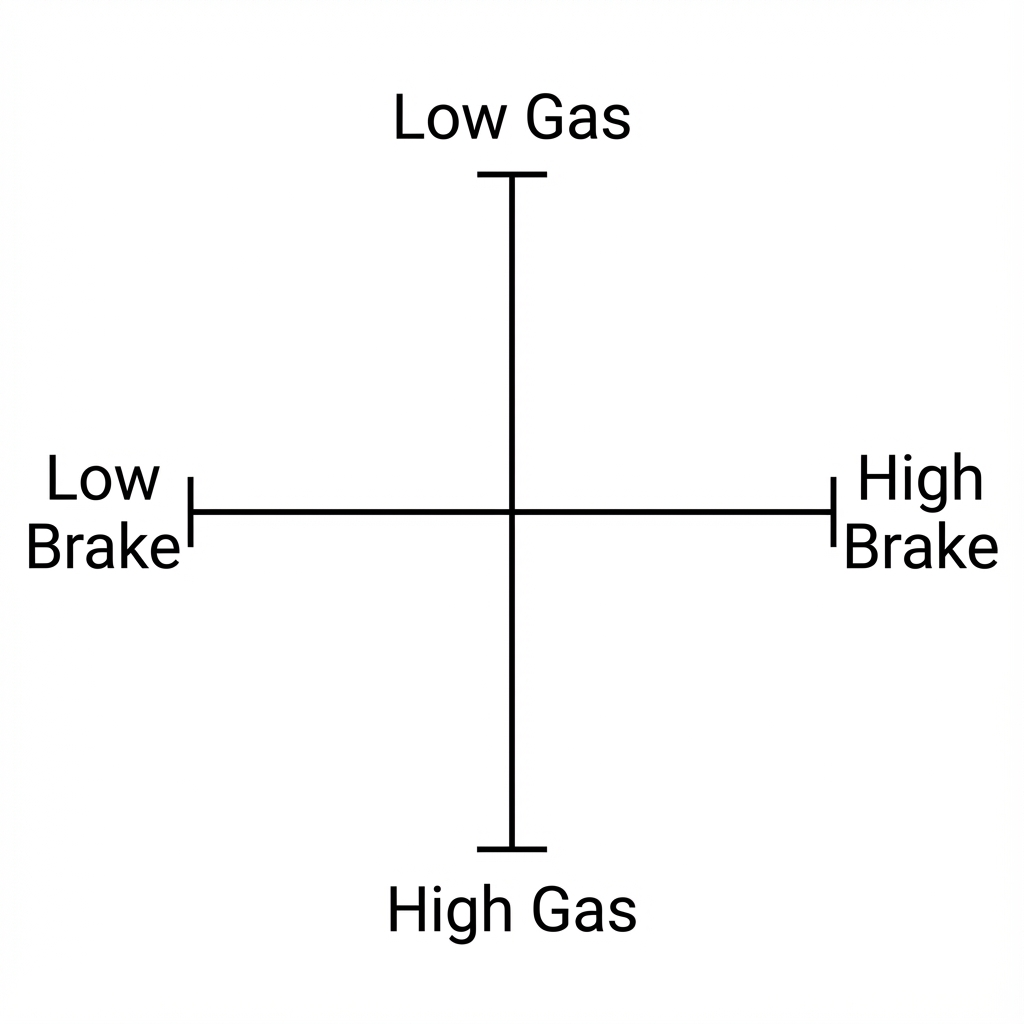
The implications of this is that you can be in a productive mood (high gas & high brake) OR you could be in a fragile state without realizing it (high gas but low brake) and get an afternoon energy crash or risk getting overstimulated.
Table of Contents
- Terms & Concepts
- Situation Effects — Overstimulation, Anxiety, Depression, Exercise, Sauna, Cold, Sleep, Breathing
- Food Effects — Hydration, Caffeine, Sugar, Protein, Alcohol, Histamine
- Supplement Effects — Magnesium, L-Theanine, Taurine, Glycine, NAC, Omega-3
Disclaimer
I am by no means an expert on this topic. All knowledge input for this article comes from ChatGPT 5.2 and Claude 4.5. Processes are way too simplified and even the most specialized people on these fields do not know the full interactions of these complex systems. Effects can also vary wildly per person. Use this article EDUCATIONALLY or better, paste it into an LLM yourself including your own context and use it as a tool to get to know yourself better and more technically.
Introducing Terms & Concepts
I will introduce several terms that will be used to puzzle all the variables and relationships together.
Neural gain or high gain: a high gain person’s brain amplifies signals, small inputs can create big responses.
GABA: the brain’s brake pedal and main inhibitory neurotransmitter, it reduces brain activity and promotes calm.
Glutamate: the brain’s gas pedal and main excitatory neurotransmitter, it increases the brain activity and alertness. It drives action, enables learning, focus and responsiveness.
Dopamine: neurotransmitter that signals reward and motivation. It says: “this is important, pay attention and go get it”.
Serotonin: dopamine’s counterbalance, it promotes mood stability, contentment and the feeling of “okay with what you have”. Helps stress response shut off faster.
Norepinephrine (noradrenaline): the brain’s alertness and focus chemical for stress and concentration. Increases arousal and vigilance without the full fight or flight intensity. (hypervigilance, scanning faces/cues)
Epinephrine (adrenaline): the body’s emergency hormone, can trigger fight-or-flight energy release, high heart rate and heightened senses, for both danger and excitement.
Acetylcholine: the brain’s spotlight chemical, it narrows focus and enhances clarity, learning and memory.
Histamine: the brain’s “stay awake” signal, maintains arousal and can trigger allergic and inflammatory responses in the body.
Glycine: inhibitory neurotransmitter similar to GABA, calming the nervous system and reducing neural excitability.
Oxytocin: the bonding chemical, released during social connection, touch and trust, promoting “relaxed openness”.
Vasopressin: oxytocin’s counterpart, focusing on vigilance and socially protective behavior.
Orexin (a.k.a. hypocretin): the “stay awake” signal, supporting histamine.
CRH (appendix only)
Testosterone (appendix only)
Estrogen (appendix only)
Progesterone (appendix only)
Cortisol: main stress chemical, causes both good and bad kinds of stress.
CRH: starting signal of the HPA axis.
Melatonin: the darkness signal, it tells the brain it’s time to sleep.
Endocannabinoids: the body’s self-produced molecules that dial down stress, pain and excessive neural firing.
BDNF: key driver of neuroplasticity and it repairs damage from stress or overstimulation.
Adenosine: the fatigue signal, it accumulates with tasks and during the day.
HPA axis (Hypothalamus-Pituitary-Adrenal axis): brain to body stress communicating system. When the brain senses threat, it signals the pituitary and the adrenals create cortisol.
Vagal tone: the strength of the vagus nerve’s calming influence. Higher tone = higher recovery and parasympathetic brake strength.
Glutathione: an antioxidant that is a main buffer for the brain, protects dopamine and serotonin from oxidative stress and from enhancing the stress loop.
Situation Effects
I will present these as a list and with little elaboration. Each situation will have a simple and a comprehensive version. The aim here is to get a sense of what is happening in your body and brain in each situation.
Social Overstimulation
For high-gain people, the simple cascading effect is: Social input → Glutamate ↑ → Norepinephrine ↑ → Cortisol ↑ → Vagal tone ↓ → GABA overwhelmed → Crash
Comprehensive:
graph TD
    A[Social input] --> B[Glutamate ↑]
    B --> C[Norepinephrine ↑]
    B --> D[ATP burn ↑]
    D --> E[Glutathione ↓]
    E --> F[Oxidative stress ↑]
    F --> G[Dopamine/Serotonin destabilize]
    G --> H[HPA axis → Cortisol ↑]
    H --> I[Vagal tone ↓]
    I --> J[Inflammation ↑]
    J --> K[More glutamate + poor cleanup]
    K --> L[GABA overwhelmed]
    C --> L
    L --> M[Adenosine ↑]
    M --> N[Crash / shutdown]
Sensory Overload
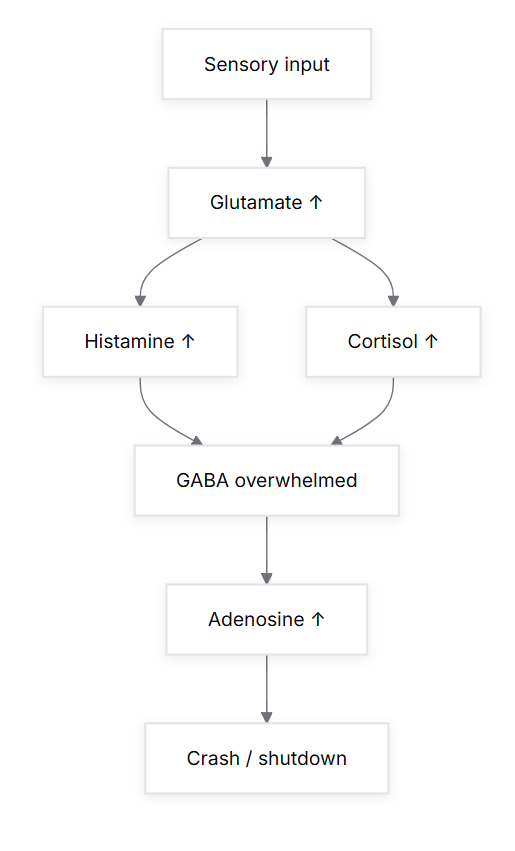
Simple version: Sensory input → Glutamate ↑ → Histamine ↑ → GABA overwhelmed → Crash
Key difference from social: Histamine is more central here, it’s the “can’t tune out” signal that keeps sensory channels wide open.
graph TD
    A[Sensory input] --> B[Glutamate ↑]
    B --> C[Histamine ↑]
    B --> D[Cortisol ↑]
    C --> E[GABA overwhelmed]
    D --> E
    E --> F[Adenosine ↑]
    F --> G[Crash / shutdown]
High-Gain Induced Anxiety
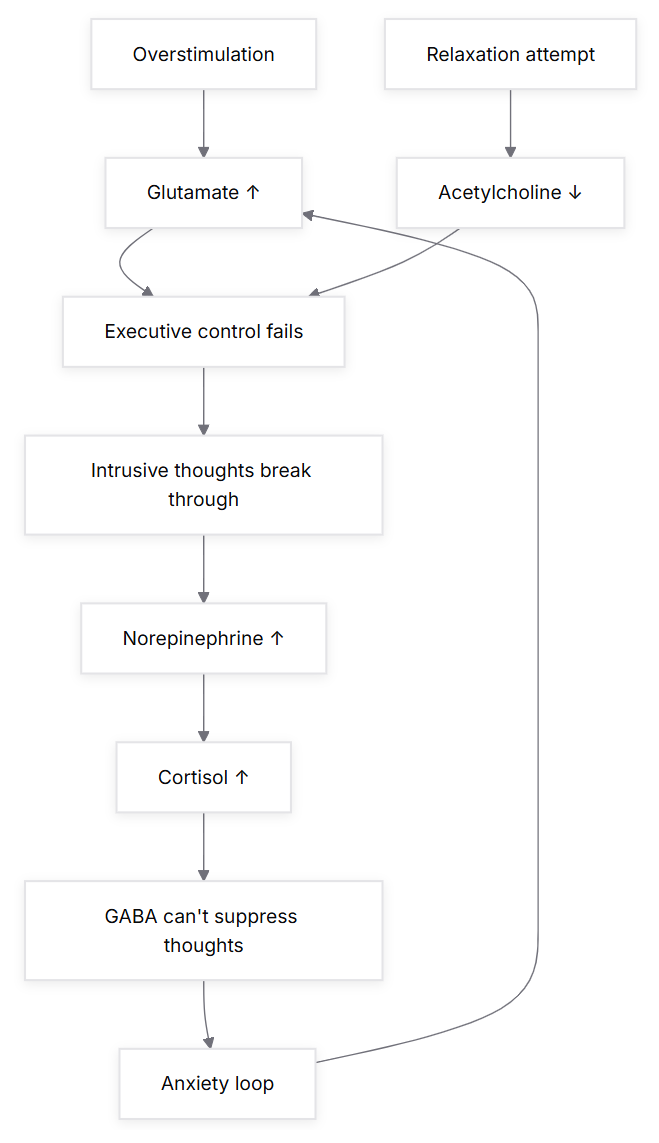
Overstimulation induced anxiety: Overstimulation → Acetylcholine depleted → Executive control ↓ → Intrusive thoughts → Anxiety
Relaxation induced anxiety: Relaxation → Executive control ↓ → Glutamate still high → Intrusive thoughts → Anxiety
graph TD
    A1[Overstimulation] --> B[Glutamate ↑]
    A2[Relaxation attempt] --> C[Acetylcholine ↓]
    B --> D[Executive control fails]
    C --> D
    D --> E[Intrusive thoughts break through]
    E --> F[Norepinephrine ↑]
    F --> G[Cortisol ↑]
    G --> H[GABA can't suppress thoughts]
    H --> I[Anxiety loop]
    I --> B
Anxiety Triggers
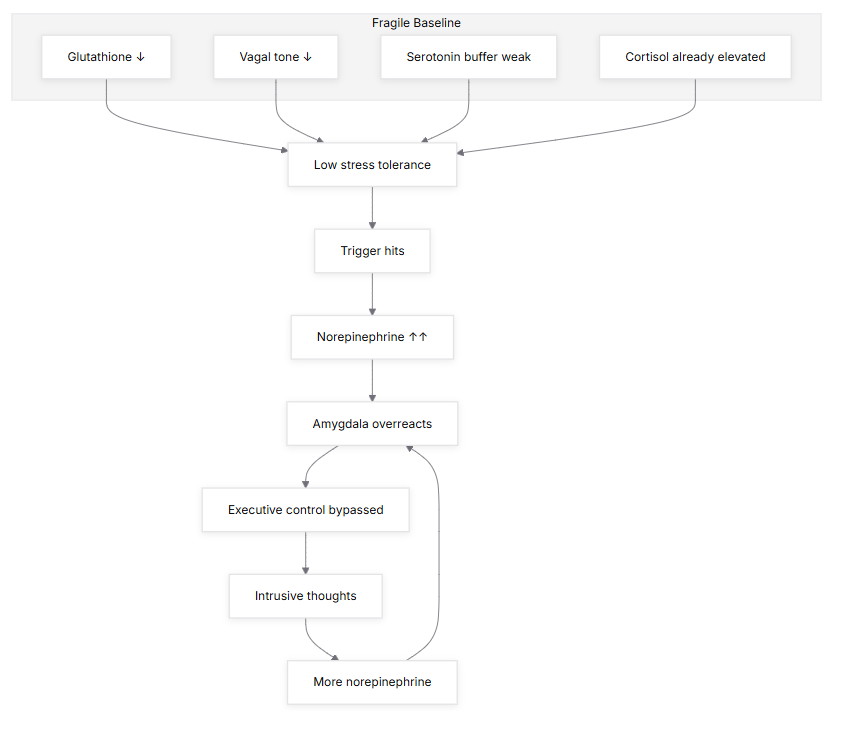
Fragile baseline → Trigger → Norepinephrine ↑ → Executive control fails → Anxiety loop
graph TD
    A[Trigger] --> B[Norepinephrine ↑]
    B --> C[Amygdala activates]
    C --> D{Serotonin buffer?}
    D -->|Strong| E[HPA feedback works]
    E --> F[Response shuts off]
    D -->|Weak| G[HPA stays on]
    G --> H[Cortisol ↑ sustained]
    H --> I[Prefrontal suppressed]
    I --> J[Executive control fails]
    J --> K[Intrusive thoughts]
    K --> L[More norepinephrine]
    L --> C
Depression
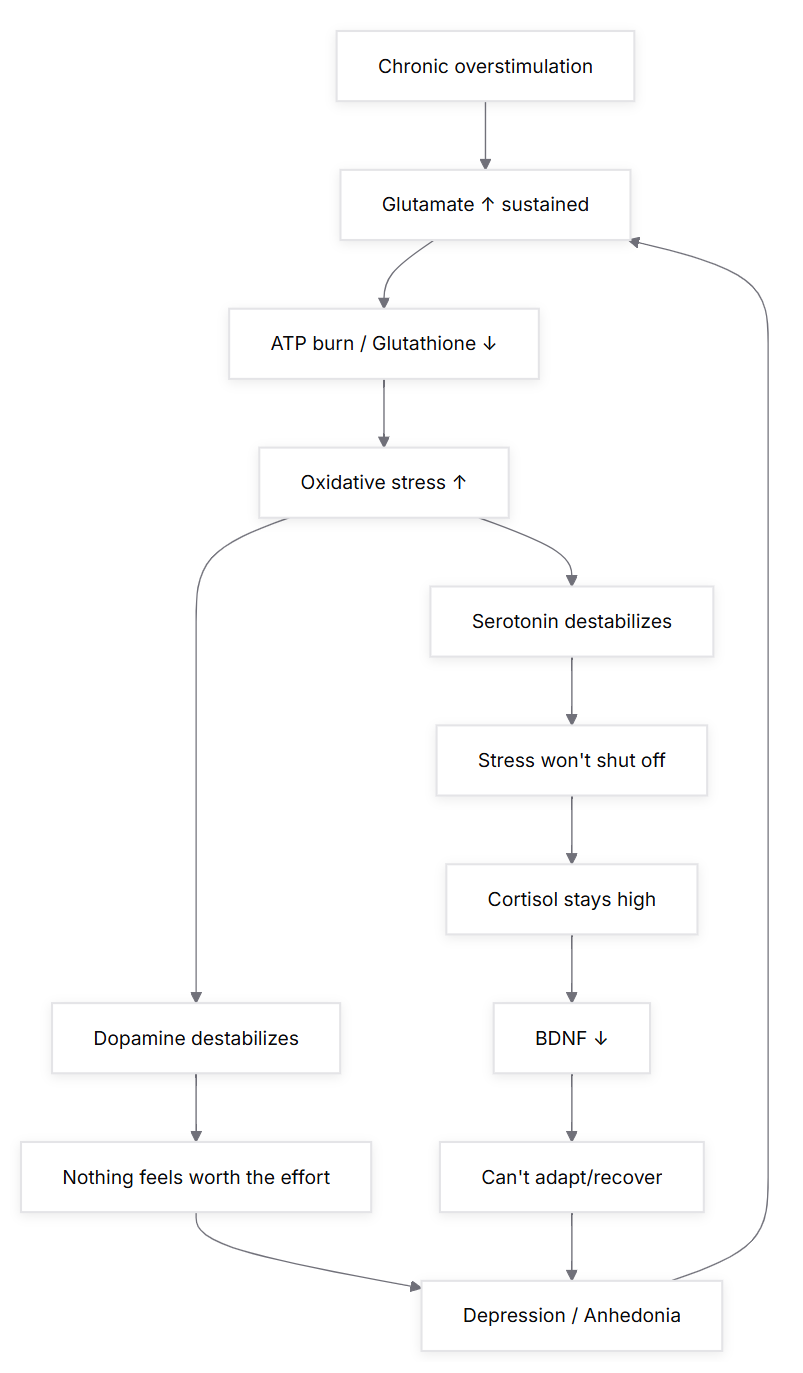
Simple version: Chronic stress → Glutathione ↓ → Dopamine/Serotonin destabilize → Effort feels pointless → Depression
It’s not necessarily the low dopamine and serotonin but the damaged dopamine and serotonin systems from chronic oxidative stress. The brain says “nothing is worth this cost” and the stress is hard to shut off.
graph TD
    A[Chronic overstimulation] --> B[Glutamate ↑ sustained]
    B --> C[ATP burn / Glutathione ↓]
    C --> D[Oxidative stress ↑]
    D --> E[Dopamine destabilizes]
    D --> F[Serotonin destabilizes]
    E --> G[Nothing feels worth the effort]
    F --> H[Stress won't shut off]
    H --> I[Cortisol stays high]
    I --> J[BDNF ↓]
    J --> K[Can't adapt/recover]
    G --> L[Depression / Anhedonia]
    K --> L
    L --> B
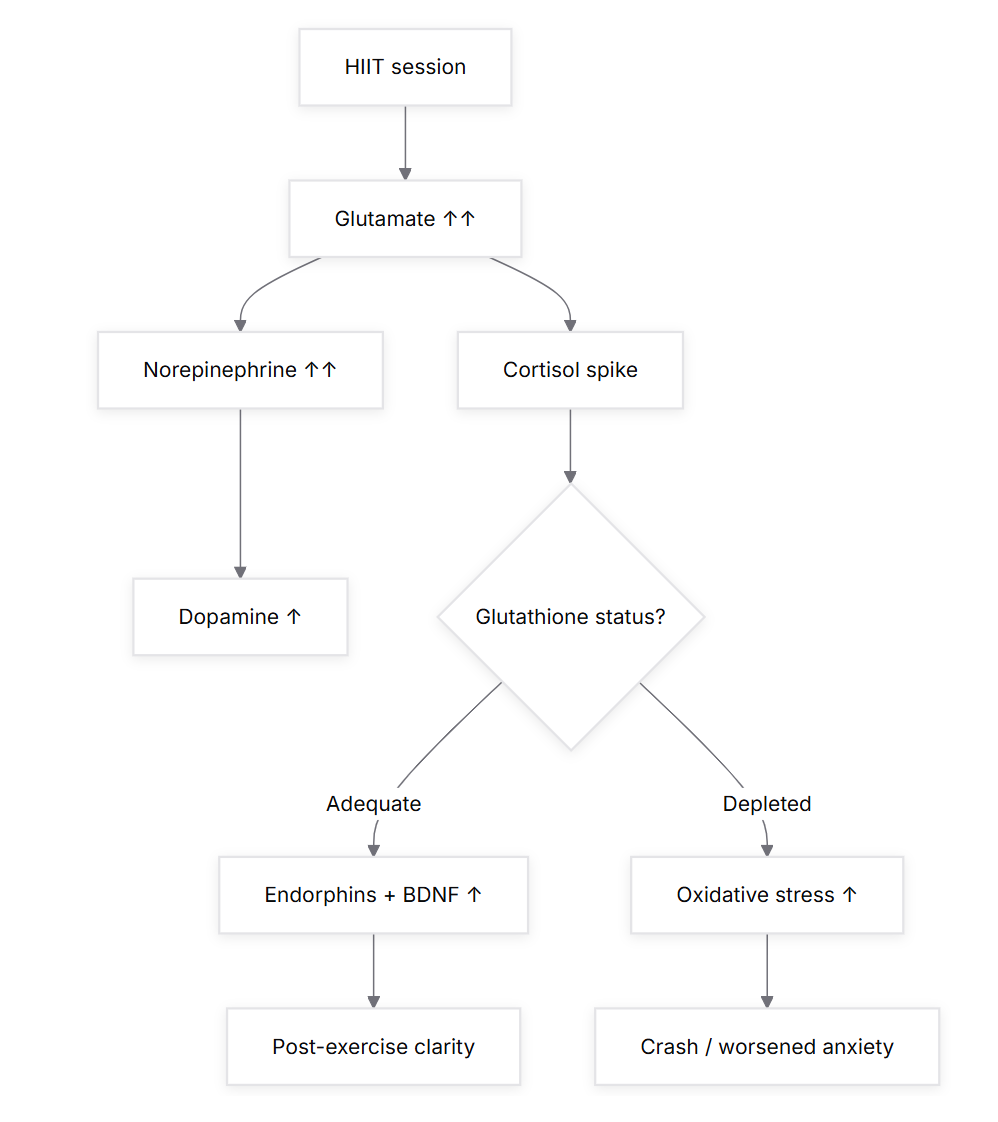
Exercise - HIIT
Intense burst → Glutamate ↑↑ → Cortisol spike → Endorphins → BDNF ↑ → Sharper (if recovered) OR crash (if depleted)
graph TD
    A[HIIT session] --> B[Glutamate ↑↑]
    B --> C[Norepinephrine ↑↑]
    B --> D[Cortisol spike]
    C --> E[Dopamine ↑]
    D --> F{Glutathione status?}
    F -->|Adequate| G[Endorphins + BDNF ↑]
    F -->|Depleted| H[Oxidative stress ↑]
    G --> I[Post-exercise clarity]
    H --> J[Crash / worsened anxiety]
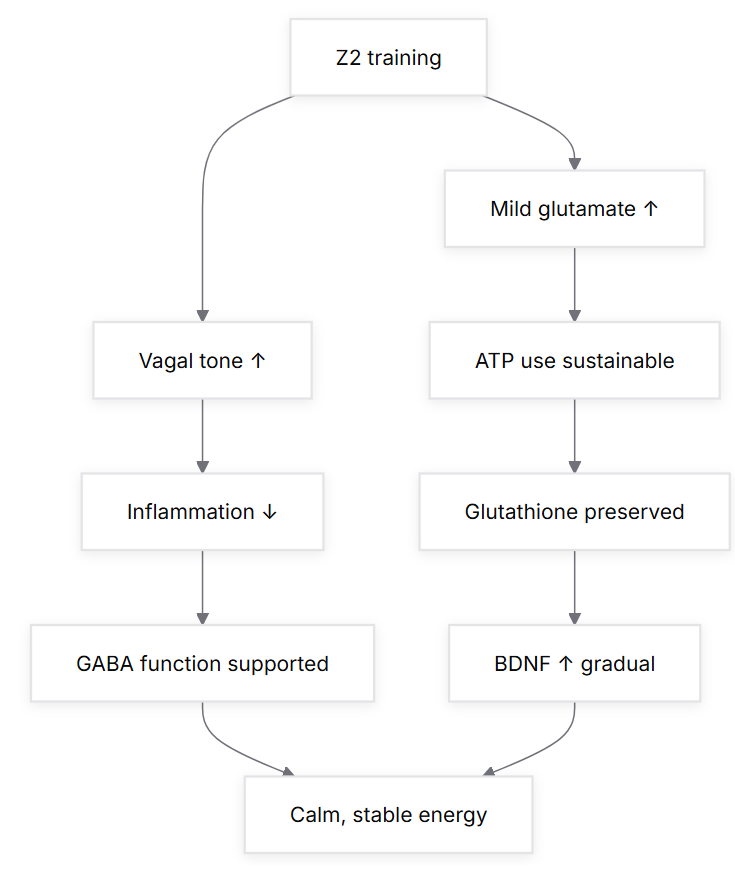
Exercise - Zone 2 Training
Gentle effort → Glutamate stable → Vagal tone ↑ → GABA supported → Calm energy
graph TD
    A[Z2 training] --> B[Mild glutamate ↑]
    B --> C[ATP use sustainable]
    C --> D[Glutathione preserved]
    A --> E[Vagal tone ↑]
    E --> F[Inflammation ↓]
    F --> G[GABA function supported]
    D --> H[BDNF ↑ gradual]
    G --> I[Calm, stable energy]
    H --> I
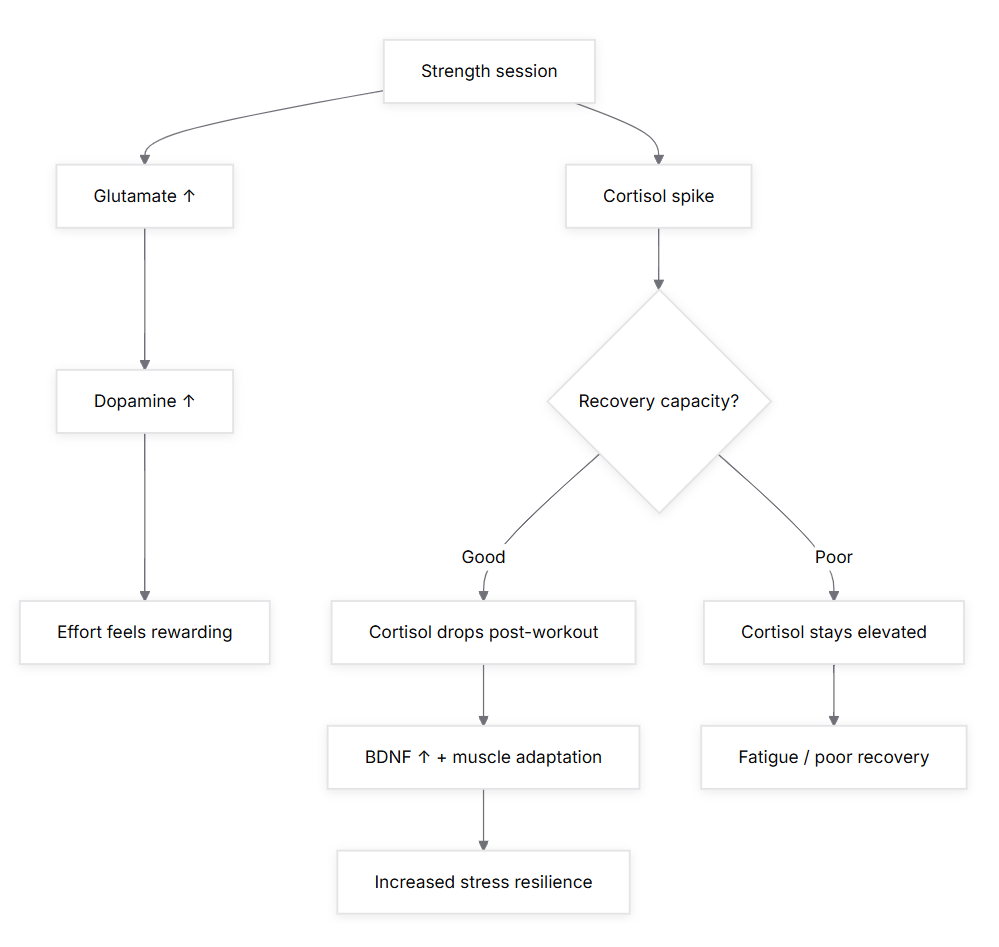
Exercise - Strength Training
Controlled effort → Dopamine ↑ → Cortisol spike + recovery → BDNF ↑ → Resilience
graph TD
    A[Strength session] --> B[Glutamate ↑]
    B --> C[Dopamine ↑]
    C --> D[Effort feels rewarding]
    A --> E[Cortisol spike]
    E --> F{Recovery capacity?}
    F -->|Good| G[Cortisol drops post-workout]
    F -->|Poor| H[Cortisol stays elevated]
    G --> I[BDNF ↑ + muscle adaptation]
    H --> J[Fatigue / poor recovery]
    I --> K[Increased stress resilience]
Exercise - Lactate (The “Burn”)
Muscle burn → Lactate shuttle → Brain fuel → Norepinephrine modulated → Anxiety threshold ↑ → Clarity
Lactate (produced during the “burn” of planks or sprints) is not just waste; it is high-octane fuel for neurons. It crosses the blood-brain barrier and can actually calm the brain’s panic center (amygdala) in the long run by acting as a signaling molecule that says “we are stressed but we have fuel,” distinguishing it from the “we are stressed and running on fumes” signal of hypoglycemia.
Note on Recovery vs. Resilience: While lactate can provide mental clarity and reduce anxiety thresholds (resilience), generating it requires effort (sympathetic activation). It is not a tool for acute recovery (calming down in the moment) but rather a tool for metabolic buffering—preventing the “low fuel” panic that often triggers anxiety.
graph TD
    A[Planks / Isometric hold] --> B[Lactate produced]
    B --> C[Shuttled to Brain]
    C --> D[Fuel for Neurons]
    D --> E[Bypasses Glucose restrictions]
    B --> F[Norepinephrine ↑]
    F --> G[Alertness]
    C --> H[Signaling Effect]
    H --> I[BDNF ↑]
    E --> J[Brain feels fueled]
    G --> K{Baseline State?}
    K -->|Stable| L[Sharp Clarity]
    K -->|Fragile| M[Anxiety / Jitters]
    J --> N[Long-term: Panic threshold ↑]
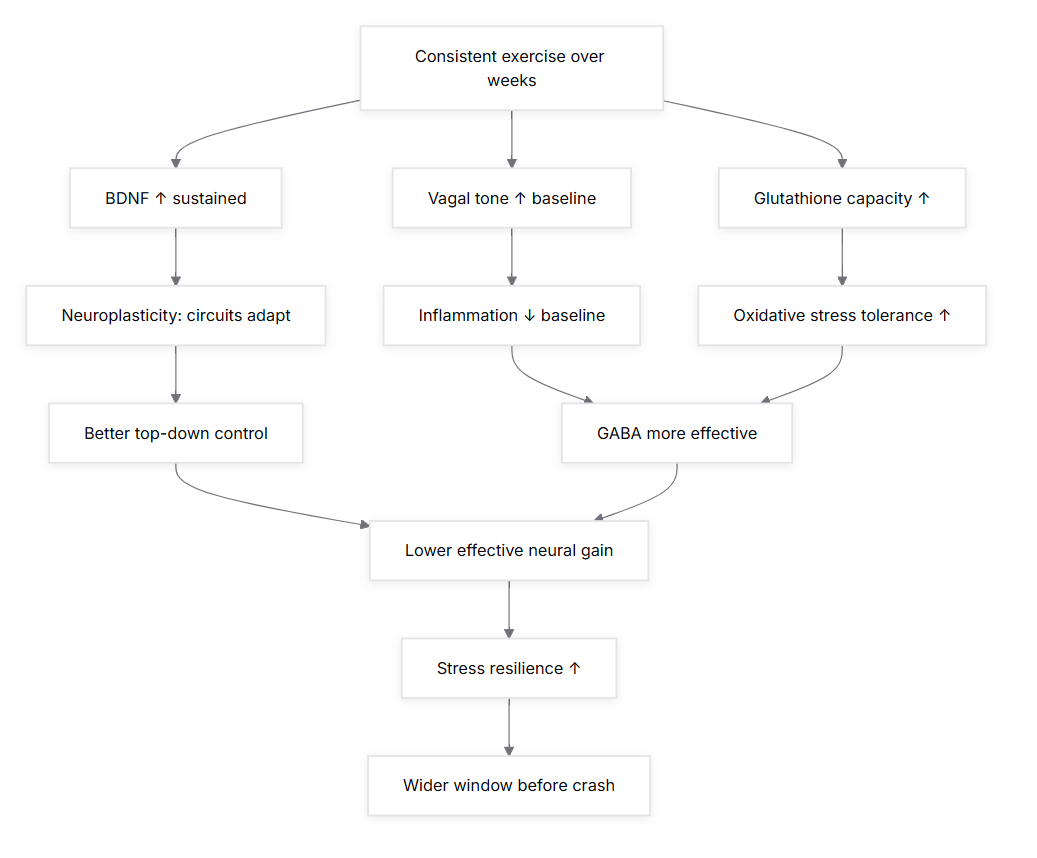
Exercise - Chronic Effects
Consistent exercise → BDNF ↑ → Vagal tone ↑ → Glutathione capacity ↑ → Lower baseline gain → Resilience
graph TD
    A[Consistent exercise] --> B[BDNF ↑]
    A --> C[Vagal tone ↑]
    B --> D[Glutathione capacity ↑]
    C --> D
    D --> E[Lower baseline gain]
    E --> F[Resilience]
Interaction: Social Overstimulation & Physical Soreness
Social Drain → Central Sensitization → Pain Amplifier ON → Repair Slowed → Soreness feels worse & lasts longer
You may notice that if you do a workout and then have a socially demanding day, the soreness (DOMS) feels significantly worse and lasts longer. This is not in your head; it is a physiological compounding effect.
- Amplification (Worse): Social overstimulation creates a high-glutamate state. Glutamate is the primary neurotransmitter for pain signaling. When your baseline glutamate is high, your brain’s “volume knob” for sensory input is turned up (Central Sensitization). Normal inflammatory signals from muscle repair are amplified into acute pain.
- Resource Theft (Longer): Social processing is metabolically expensive. A high-gain brain facing social threat/processing hogs glucose and ATP. The energy resources needed for muscle protein synthesis are diverted to fueling the anxious brain.
- Hormonal Blockade (Longer): Social stress keeps cortisol elevated. Cortisol is catabolic (breaks down tissue). Recovery requires an anabolic state. You are essentially pressing the gas and brake on recovery at the same time.
graph TD
    A[Muscle Micro-tears] --> B[Inflammation Signals]
    C[Social Overstimulation] --> D[Glutamate ↑]
    C --> E[Cortisol ↑]
    C --> F[Energy Drain]
    D --> G[Central Sensitization]
    G --> H[Pain signal amplified]
    B --> H
    H --> I[Soreness feels acute]
    E --> J[Catabolic State]
    F --> J
    J --> K[Repair slowed down]
    K --> L[Soreness lasts longer]
Sauna
Heat stress → Norepinephrine ↑ → Heat shock proteins ↑ → BDNF ↑ → Endorphins → Deep relaxation (if not overdone)
Sauna creates controlled heat stress that triggers beneficial adaptations. The initial stress response (norepinephrine spike) is followed by a parasympathetic rebound. Heat shock proteins protect neurons and support recovery. The key is duration: too short = no benefit, too long = depletes rather than restores.
graph TD
    A[Sauna session] --> B[Core temperature ↑]
    B --> C[Norepinephrine ↑↑]
    B --> D[Heat shock proteins ↑]
    C --> E[Alertness spike]
    D --> F[Cellular protection]
    D --> G[BDNF ↑]
    B --> H{Duration appropriate?}
    H -->|Yes: 15-25 min| I[Endorphins release]
    H -->|Too long| J[Glutathione depleted]
    I --> K[Parasympathetic rebound]
    K --> L[Vagal tone ↑]
    L --> M[Deep relaxation]
    G --> N[Neuroplasticity supported]
    M --> O[Improved stress resilience]
    N --> O
    J --> P[Fatigue / worsened recovery]
Cold Shower
Cold exposure → Norepinephrine ↑↑ → Dopamine ↑ → Vagal tone ↑ → Mental clarity + Mood boost
Cold showers provide a rapid sympathetic activation followed by parasympathetic adaptation. The norepinephrine spike is significant (200-300% increase) and sustained for hours. Unlike heat, cold exposure trains the vagus nerve directly through the cold shock response.
graph TD
    A[Cold shower] --> B[Cold shock response]
    B --> C[Norepinephrine ↑↑↑]
    B --> D[Epinephrine ↑]
    C --> E[Dopamine ↑ sustained]
    D --> F[Acute alertness]
    B --> G[Vagus nerve activated]
    G --> H[Vagal tone ↑]
    H --> I[Parasympathetic capacity ↑]
    E --> J[Mood elevation lasting hours]
    F --> K{Baseline state?}
    K -->|Recovered| L[Mental clarity + energy]
    K -->|Already depleted| M[Stress adds to load]
    I --> N[Better stress recovery later]
    L --> O[Increased resilience]
    N --> O
    M --> P[Temporary boost but net drain]
Cold Bath / Ice Bath
Prolonged cold → Norepinephrine ↑↑↑ → Inflammatory response ↓ → Deep parasympathetic shift → Recovery enhanced
Cold baths provide deeper and more sustained cold exposure than showers. The anti-inflammatory effect is more pronounced, and the vagal training is stronger. However, the stress load is also higher, so timing matters: avoid immediately after strength training (blunts adaptation) but excellent for recovery days or after high-stress periods.
graph TD
    A[Cold bath / ice bath] --> B[Sustained cold exposure]
    B --> C[Norepinephrine ↑↑↑]
    B --> D[Vasoconstriction]
    D --> E[Blood flow to core]
    B --> F[Cold shock proteins ↑]
    F --> G[Cellular stress resistance ↑]
    C --> H[Dopamine ↑ prolonged]
    B --> I[Inflammation ↓↓]
    I --> J[Cytokines reduced]
    J --> K[Microglia calmer]
    K --> L[Less neural inflammation]
    B --> M[Vagus nerve strongly activated]
    M --> N[Vagal tone ↑↑]
    N --> O[Parasympathetic dominance]
    H --> P[Mood + motivation boost]
    L --> Q[Lower baseline gain]
    O --> Q
    Q --> R[Enhanced recovery capacity]
    P --> R
    G --> R
⚠️ Caution for High-Gain Individuals
While sauna and cold exposure have documented benefits, high-gain nervous systems should approach these protocols with extra caution:
The problem: These interventions work through controlled stress. But if your baseline is already elevated (high glutamate, low GABA buffer, depleted glutathione), adding more stress - even “good” stress - can tip you over rather than build resilience.
What can go wrong:
- Norepinephrine overload: Cold exposure spikes norepinephrine 200-300%. For a sensitive system already running hot, this can trigger anxiety, insomnia, or leave you wired-but-tired
- Cortisol stacking: If your HPA axis is already overactive, repeated thermal stress may compound rather than reset your stress hormones
- Glutathione depletion: Both heat and cold stress use antioxidant capacity. If you’re already depleted from chronic stress, these protocols can drain you further
- Histamine release: Heat exposure can trigger histamine release from mast cells, potentially worsening symptoms in histamine-sensitive individuals
Practical guidelines:
- Start very mild: 30 seconds cold, 5 minutes sauna. Observe your response over 24-48 hours
- Skip when fragile: If you’re already overstimulated, sleep-deprived, or in a stress peak, these protocols add load rather than recovery
- Watch for warning signs: Racing thoughts after, poor sleep that night, increased anxiety, or feeling worse the next day = too much
- Prioritize fundamentals first: Sleep, nutrition, and stress management should be solid before adding hormetic stressors
The goal is adaptation, not depletion. A high-gain system needs a higher margin of safety.
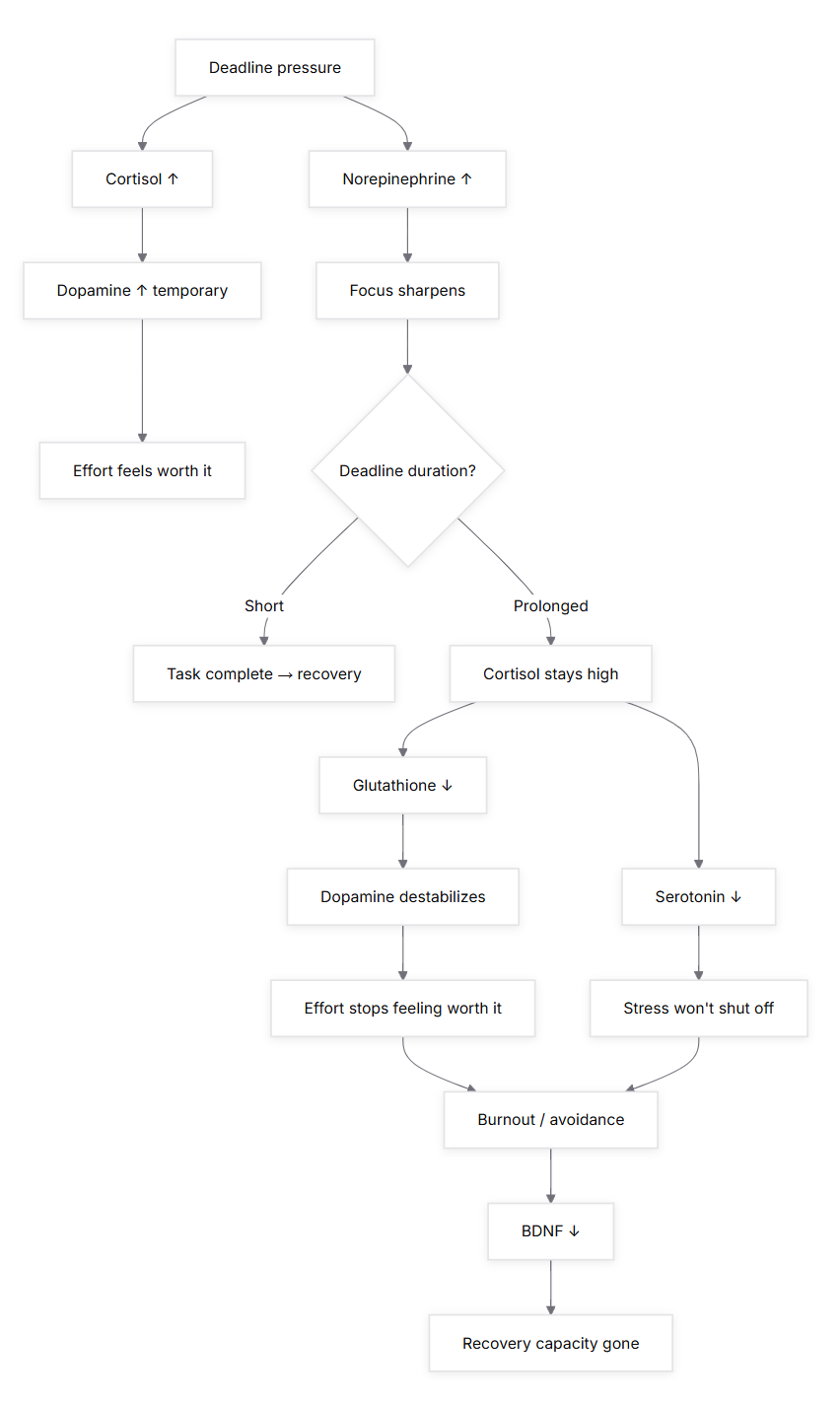
Stress and Deadlines
Deadline pressure → Norepinephrine ↑ → Dopamine ↑ (short-term) → Cortisol ↑ sustained → Dopamine crashes → Burnout
graph TD
    A[Deadline pressure] --> B[Norepinephrine ↑]
    A --> C[Cortisol ↑]
    B --> D[Focus sharpens]
    C --> E[Dopamine ↑ temporary]
    E --> F[Effort feels worth it]
    D --> G{Deadline duration?}
    G -->|Short| H[Task complete → recovery]
    G -->|Prolonged| I[Cortisol stays high]
    I --> J[Glutathione ↓]
    J --> K[Dopamine destabilizes]
    K --> L[Effort stops feeling worth it]
    I --> M[Serotonin ↓]
    M --> N[Stress won't shut off]
    L --> O[Burnout / avoidance]
    N --> O
    O --> P[BDNF ↓]
    P --> Q[Recovery capacity gone]
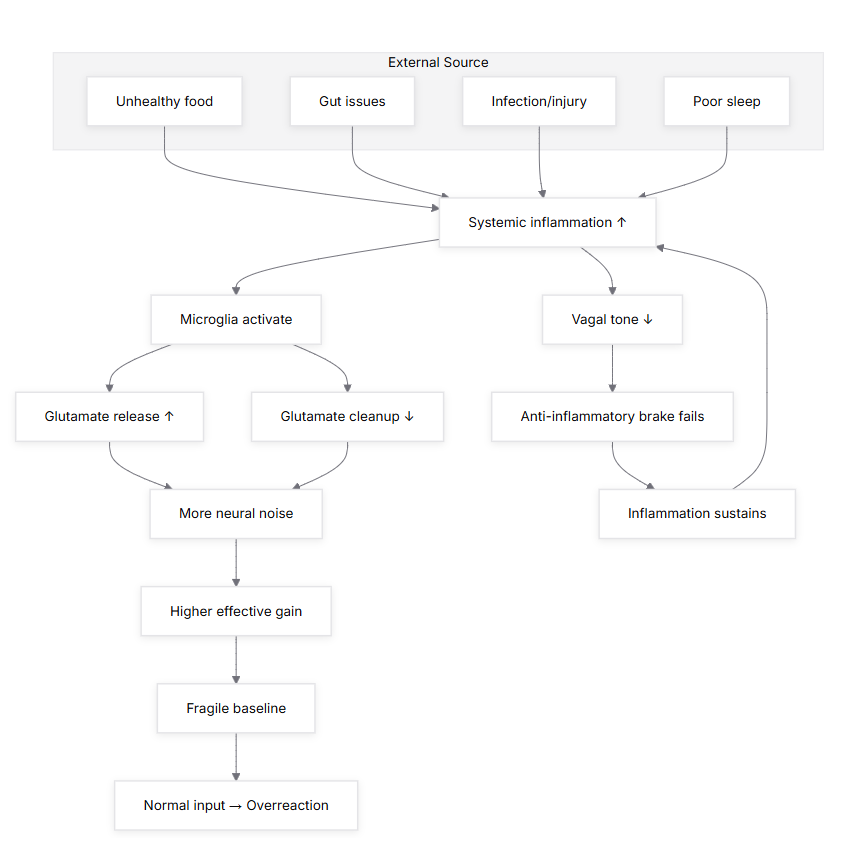
Inflammation
Inflammation → Vagal tone ↓ → Glutamate cleanup ↓ → Brain more fragile → Easier crash
graph TD
    subgraph External Source
        E1[Unhealthy food]
        E2[Gut issues]
        E3[Infection/injury]
        E4[Poor sleep]
    end
    E1 --> A[Systemic inflammation ↑]
    E2 --> A
    E3 --> A
    E4 --> A
    A --> B[Vagal tone ↓]
    A --> C[Microglia activate]
    B --> D[Anti-inflammatory brake fails]
    C --> E[Glutamate release ↑]
    C --> F[Glutamate cleanup ↓]
    E --> G[More neural noise]
    F --> G
    D --> H[Inflammation sustains]
    H --> A
    G --> I[Higher effective gain]
    I --> J[Fragile baseline]
    J --> K[Normal input → Overreaction]
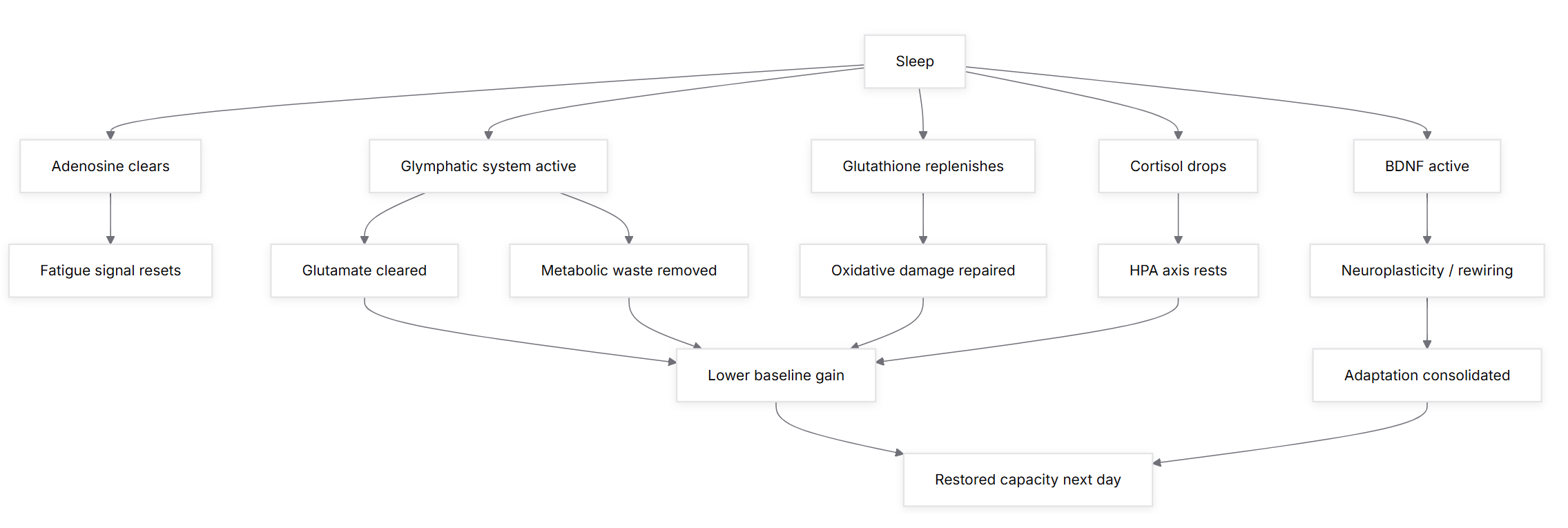
Sleep
Sleep → Glutathione replenishes → BDNF active → Adenosine clears → Glymphatic cleanup → System resets
graph TD
    A[Sleep] --> B[Adenosine clears]
    B --> C[Fatigue signal resets]
    A --> D[Cortisol drops]
    D --> E[HPA axis rests]
    A --> F[Glymphatic system active]
    F --> G[Glutamate cleared]
    F --> H[Metabolic waste removed]
    A --> I[Glutathione replenishes]
    I --> J[Oxidative damage repaired]
    A --> K[BDNF active]
    K --> L[Neuroplasticity / rewiring]
    G --> M[Lower baseline gain]
    H --> M
    J --> M
    E --> M
    L --> N[Adaptation consolidated]
    M --> O[Restored capacity next day]
    N --> O
Breathing
Slow breathing → CO₂ ↑ → Vagal tone ↑ → Acetylcholine ↑ → Inflammation ↓ + Heart rate ↓ → Calm
graph TD
    A[Overbreathing / stress] --> B[CO₂ ↓]
    B --> C[Nerves more excitable]
    C --> D[Anxiety / lightheadedness]
    E[Slow breathing] --> F[CO₂ ↑ tolerated]
    F --> G[Vagus nerve activated]
    G --> H[Acetylcholine ↑]
    H --> I[Heart rate ↓]
    H --> J[Inflammation ↓]
    J --> K[Microglia calmer]
    K --> L[Less glutamate release]
    G --> M[Parasympathetic engaged]
    M --> N[GABA function supported]
    I --> O[Lower arousal]
    L --> O
    N --> O
    O --> P[Trainable brake]
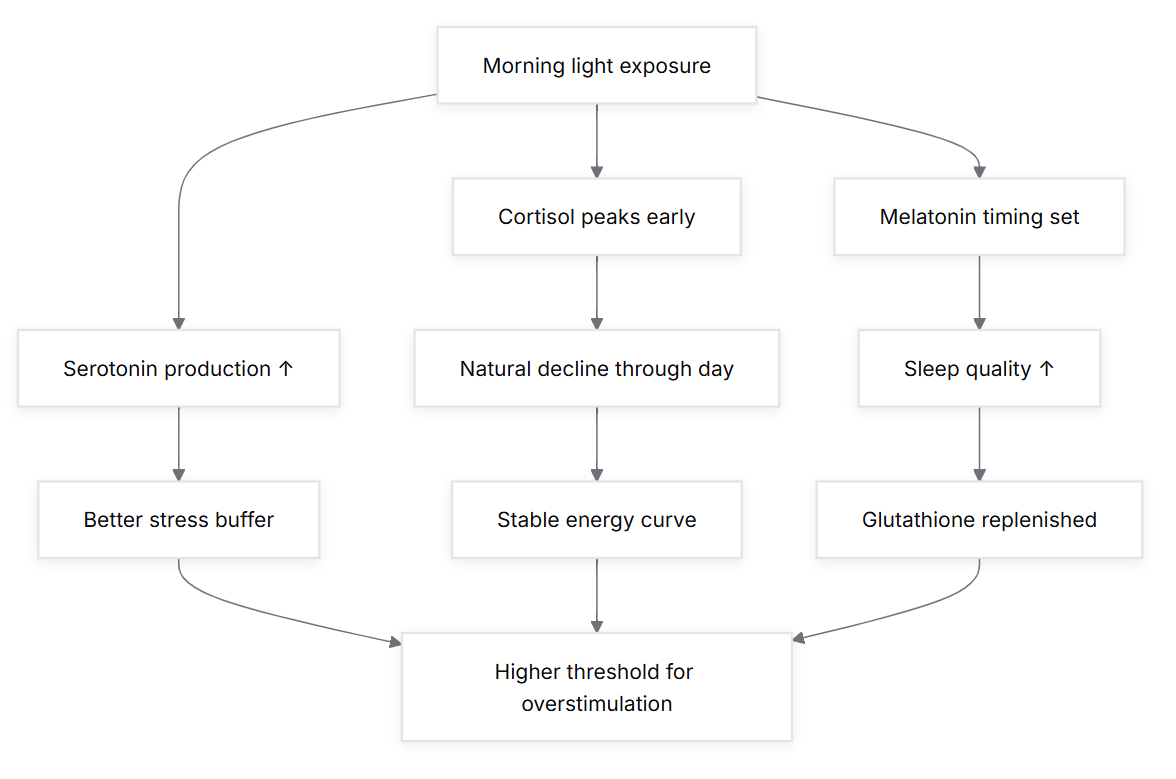
Morning Light Exposure
Morning light → Cortisol peaks early → Melatonin timed correctly → Stable energy curve → Less fragile by afternoon
graph TD
    A[Morning light exposure] --> B[Cortisol peaks early]
    B --> C[Natural decline through day]
    A --> D[Melatonin timing set]
    D --> E[Sleep quality ↑]
    A --> F[Serotonin production ↑]
    F --> G[Better stress buffer]
    C --> H[Stable energy curve]
    E --> I[Glutathione replenished]
    G --> J[Higher threshold for overstimulation]
    H --> J
    I --> J
Daydream mental recovery (zoning out)
Zoning out → DMN active → Prefrontal rests → Glutamate demand ↓ → Passive recovery
Your executive control is always on with a cognitive coping strategy, that constantly uses glutamate and ATP. DMN is the brain idle mode, allowing top-down brain networks time to recover.
graph TD
    A[Zoning out] --> B[Default Mode Network active]
    B --> C[Prefrontal cortex rests]
    C --> D[Executive control paused]
    D --> E[Glutamate demand ↓]
    E --> F[ATP conserved]
    F --> G[Glutathione spared]
    B --> H[Mind wandering / daydreaming]
    H --> I[No external input to process]
    I --> J[Sensory load ↓]
    J --> K[Histamine / norepinephrine ease off]
    G --> L[Passive recovery]
    K --> L
    L --> M[Capacity restored]
Food Effects
Hydration
Dehydration → Cell function ↓ → Cortisol ↑ → Histamine ↑ → Lower stress tolerance
graph TD
    A[Dehydration] --> B[Cell volume ↓]
    B --> C[Neurotransmitter signaling impaired]
    A --> D[Cortisol ↑]
    D --> E[Stress response activated]
    A --> F[Histamine ↑]
    F --> G[Arousal ↑]
    C --> H[Brain fog]
    E --> I[Lower stress tolerance]
    G --> I
    H --> I
    I --> J[Fragile baseline]
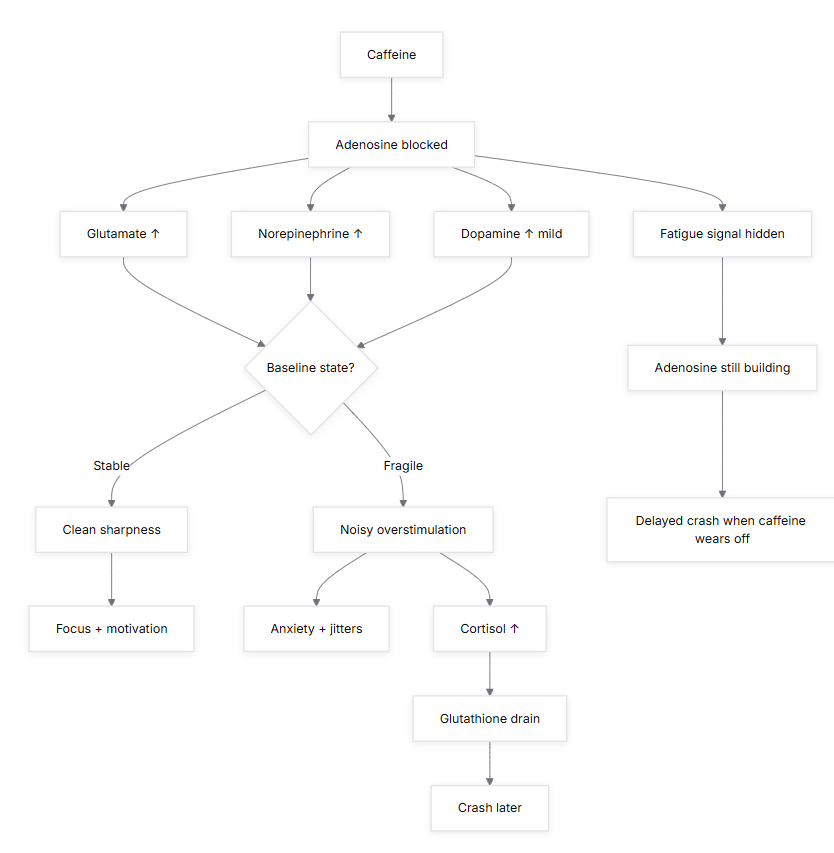
Caffeine
Caffeine → Adenosine blocked → Glutamate ↑ + Norepinephrine ↑ + Dopamine ↑ → Sharp OR overstimulated (depends on baseline)
graph TD
    A[Caffeine] --> B[Adenosine blocked]
    B --> C[Fatigue signal hidden]
    B --> D[Glutamate ↑]
    B --> E[Norepinephrine ↑]
    B --> F[Dopamine ↑ mild]
    D --> G{Baseline state?}
    E --> G
    F --> G
    G -->|Stable| H[Clean sharpness]
    G -->|Fragile| I[Noisy overstimulation]
    H --> J[Focus + motivation]
    I --> K[Anxiety + jitters]
    I --> L[Cortisol ↑]
    L --> M[Glutathione drain]
    M --> N[Crash later]
    C --> O[Adenosine still building]
    O --> P[Delayed crash when caffeine wears off]
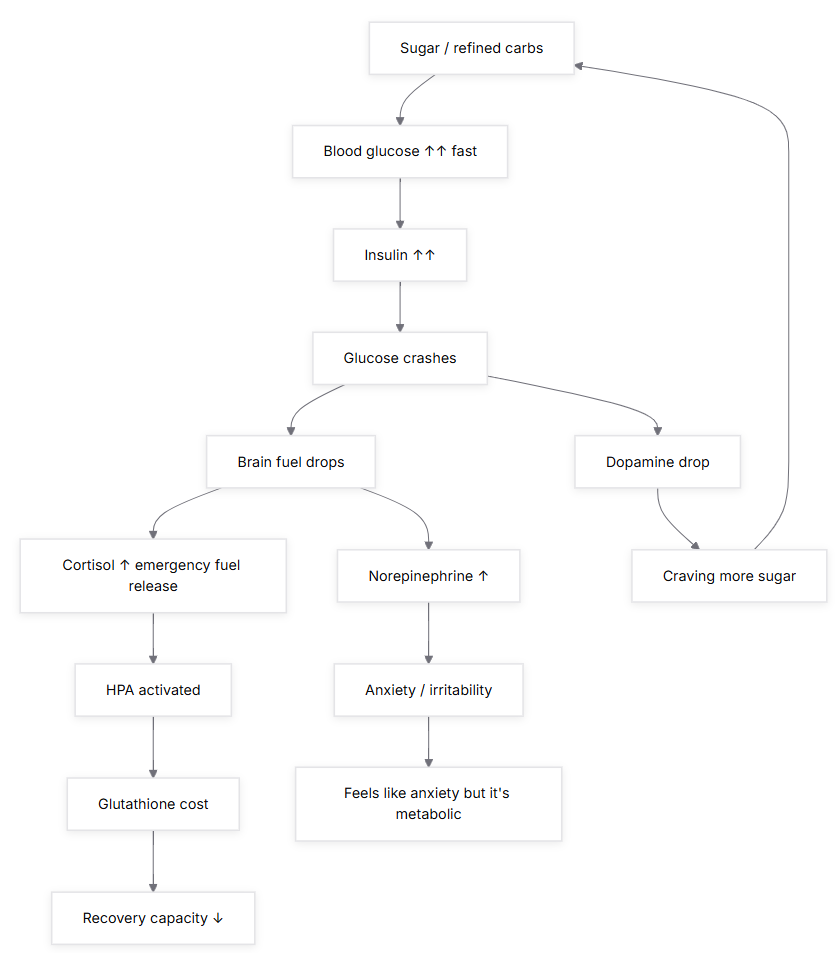
Sugar and Carbs
Sugar → Blood glucose spike → Insulin spike → Glucose crash → Cortisol ↑ to compensate → Fragile state
graph TD
    A[Sugar / refined carbs] --> B[Blood glucose ↑↑ fast]
    B --> C[Insulin ↑↑]
    C --> D[Glucose crashes]
    D --> E[Brain fuel drops]
    E --> F[Cortisol ↑ emergency fuel release]
    E --> G[Norepinephrine ↑]
    F --> H[HPA activated]
    G --> I[Anxiety / irritability]
    H --> J[Glutathione cost]
    I --> K[Feels like anxiety but it's metabolic]
    J --> L[Recovery capacity ↓]
    D --> M[Dopamine drop]
    M --> N[Craving more sugar]
    N --> A
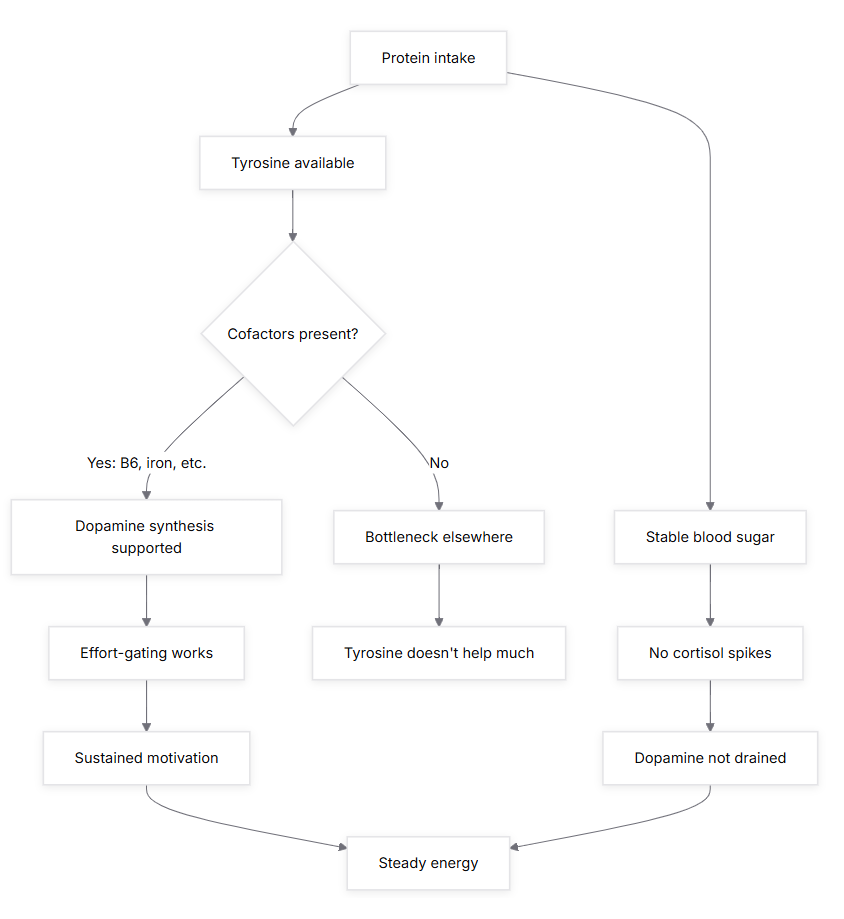
Protein (and Tyrosine)
Protein → Tyrosine → Dopamine precursor available → Sustained drive (if cofactors present)
graph TD
    A[Protein intake] --> B[Tyrosine available]
    B --> C{Cofactors present?}
    C -->|Yes: B6, iron, etc.| D[Dopamine synthesis supported]
    C -->|No| E[Bottleneck elsewhere]
    D --> F[Effort-gating works]
    F --> G[Sustained motivation]
    A --> H[Stable blood sugar]
    H --> I[No cortisol spikes]
    I --> J[Dopamine not drained]
    G --> K[Steady energy]
    J --> K
    E --> L[Tyrosine doesn't help much]
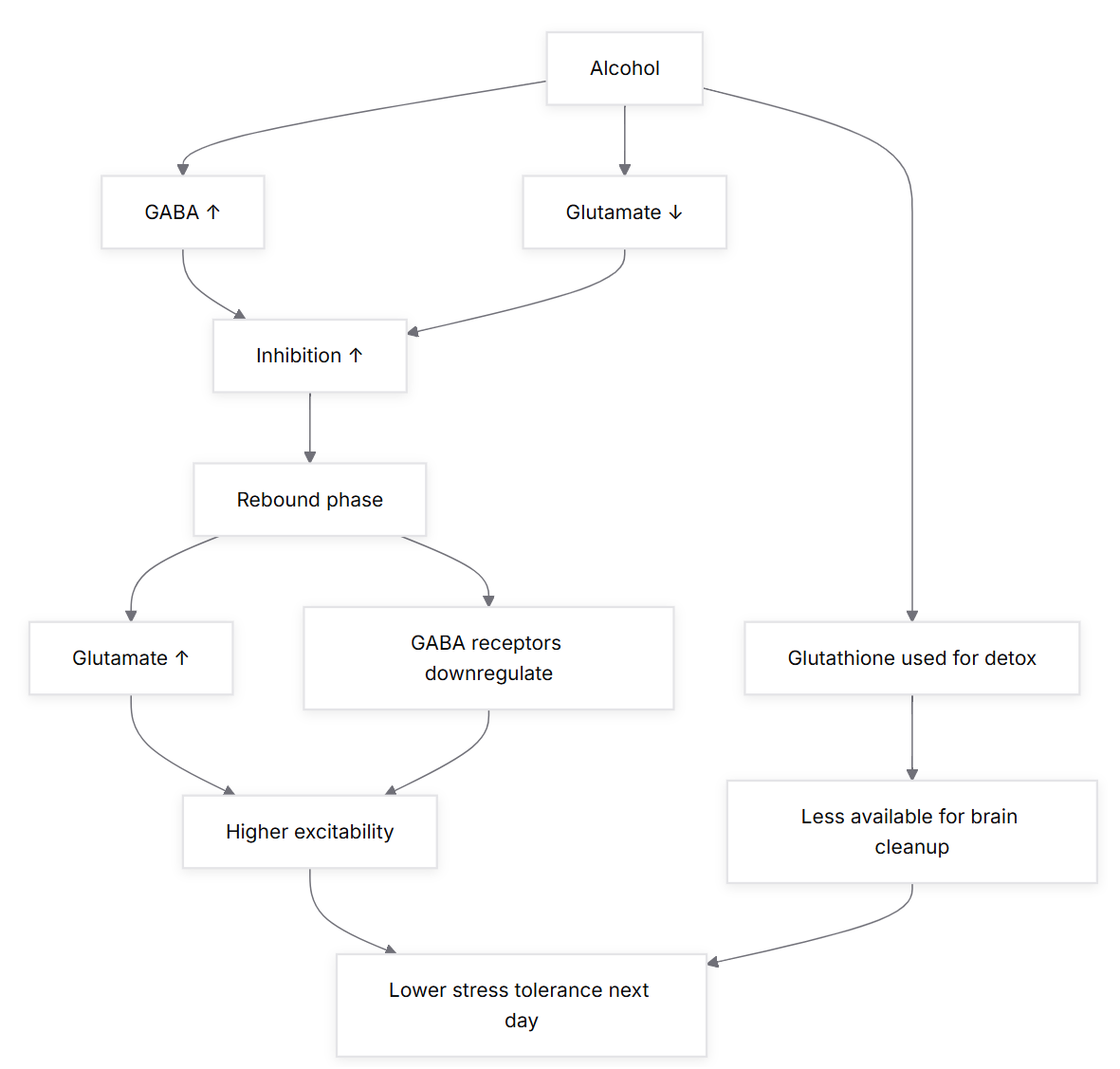
Alcohol
Alcohol → GABA ↑ + Glutamate ↓ → Rebound: Glutamate ↑ + GABA sensitivity ↓ → Lower baseline next day
graph TD
    A[Alcohol] --> B[GABA ↑]
    A --> C[Glutamate ↓]
    B --> D[Inhibition ↑]
    C --> D
    D --> E[Rebound phase]
    E --> F[Glutamate ↑]
    E --> G[GABA receptors downregulate]
    F --> H[Higher excitability]
    G --> H
    A --> I[Glutathione used for detox]
    I --> J[Less available for brain cleanup]
    H --> K[Lower stress tolerance next day]
    J --> K
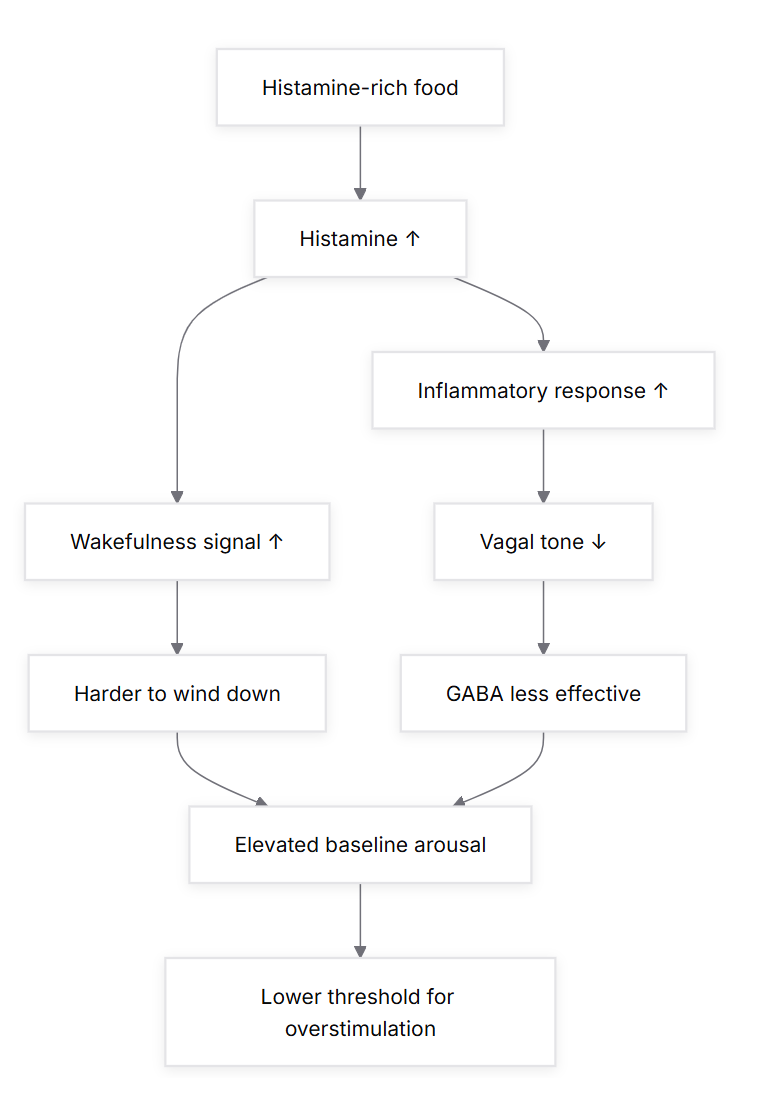
Histamine
Histamine-rich food → Histamine ↑ → Arousal ↑ + Inflammation ↑ → Harder to calm down
If you already run hot (high histamine/arousal), these foods add fuel. Especially problematic in evening when you need histamine to drop for sleep.
graph TD
    A[Histamine-rich food] --> B[Histamine ↑]
    B --> C[Wakefulness signal ↑]
    B --> D[Inflammatory response ↑]
    C --> E[Harder to wind down]
    D --> F[Vagal tone ↓]
    F --> G[GABA less effective]
    E --> H[Elevated baseline arousal]
    G --> H
    H --> I[Lower threshold for overstimulation]
Supplement Effects
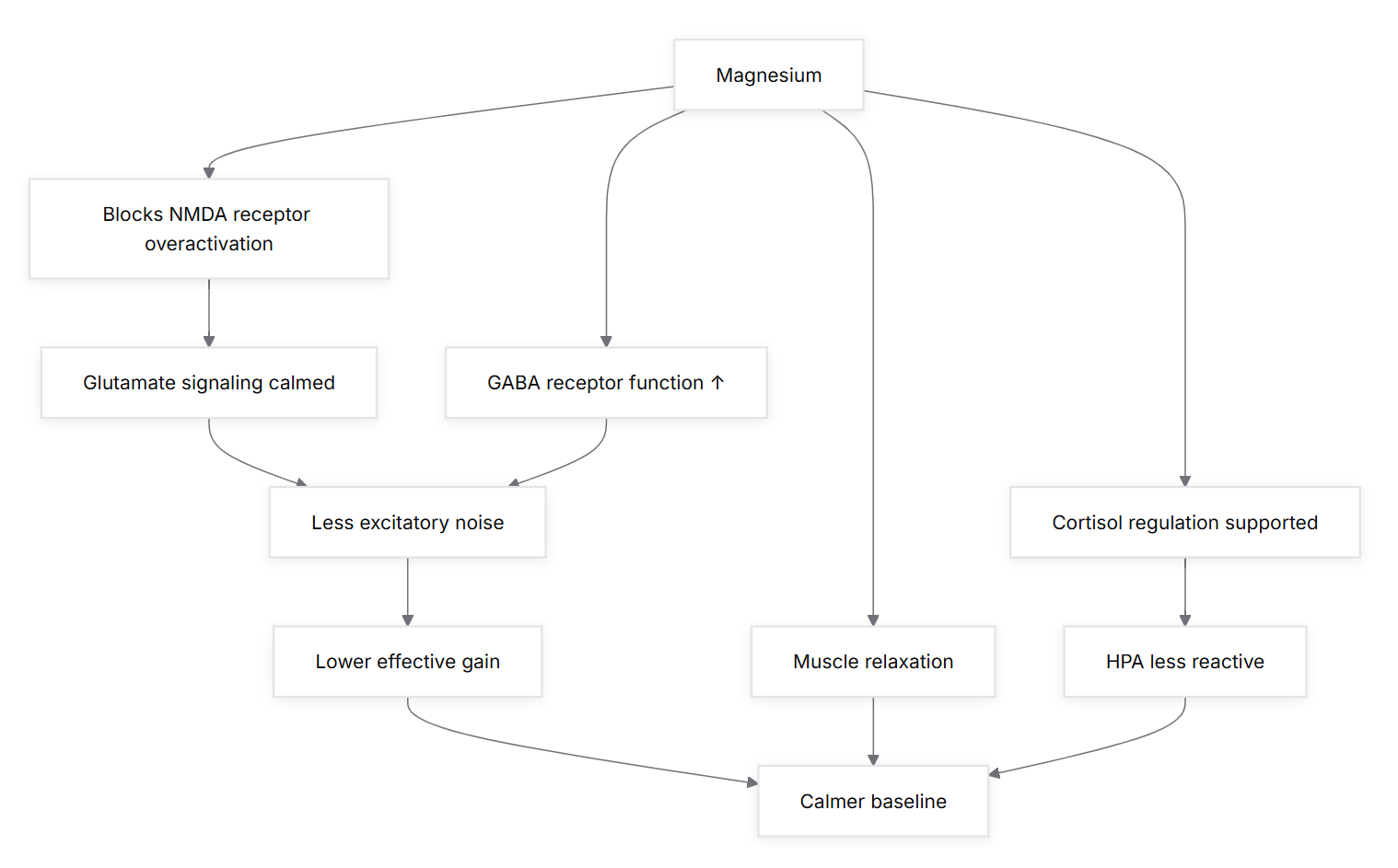
Magnesium
Magnesium → Glutamate receptor calmed → GABA function supported → Lower gain, easier relaxation
Can be depleted by stress.
graph TD
    A[Magnesium] --> B[Blocks NMDA receptor overactivation]
    B --> C[Glutamate signaling calmed]
    A --> D[GABA receptor function ↑]
    C --> E[Less excitatory noise]
    D --> E
    E --> F[Lower effective gain]
    A --> G[Muscle relaxation]
    A --> H[Cortisol regulation supported]
    H --> I[HPA less reactive]
    F --> J[Calmer baseline]
    G --> J
    I --> J
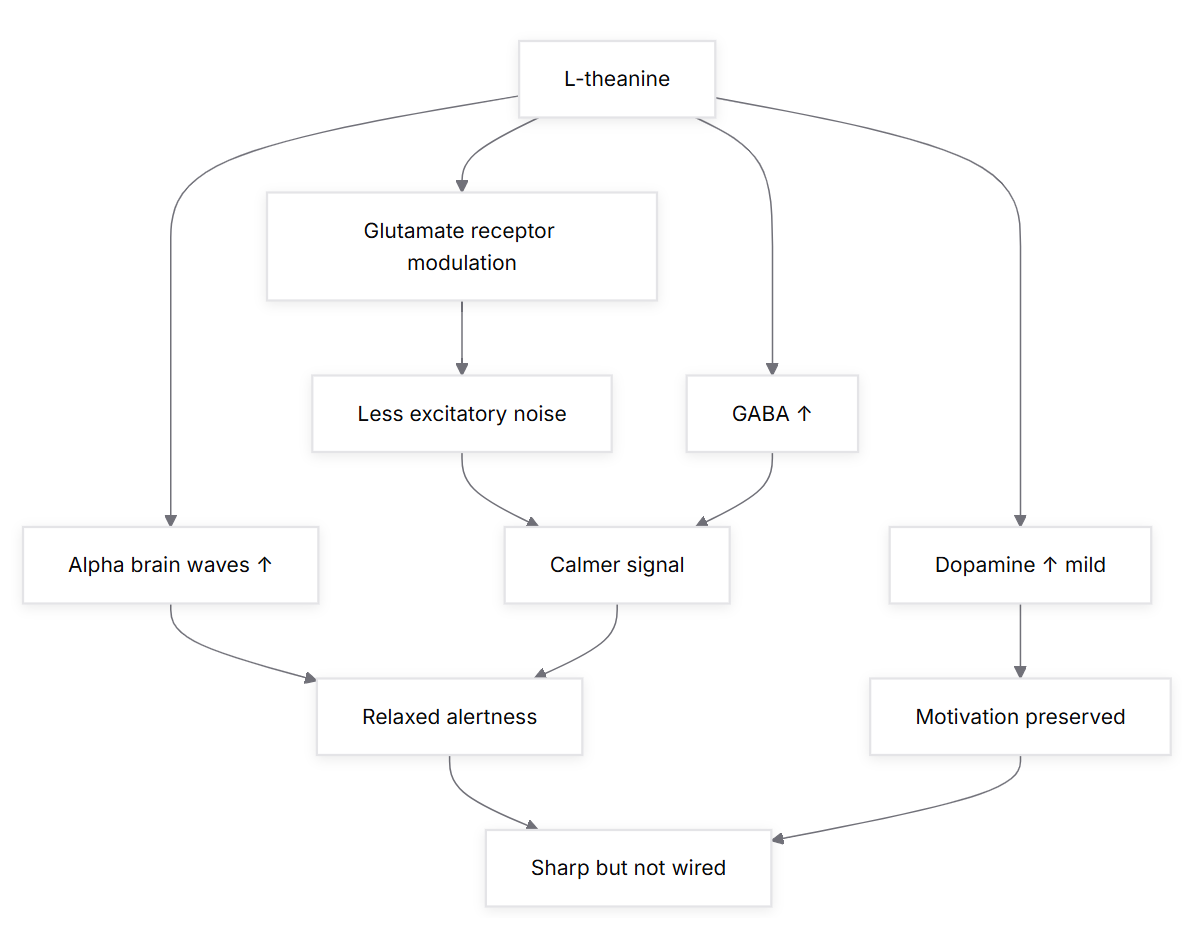
L-Theanine
L-theanine → Glutamate modulated → GABA ↑ → Calm focus without sedation
graph TD
    A[L-theanine] --> B[Glutamate receptor modulation]
    B --> C[Less excitatory noise]
    A --> D[GABA ↑]
    A --> E[Alpha brain waves ↑]
    C --> F[Calmer signal]
    D --> F
    E --> G[Relaxed alertness]
    F --> G
    A --> H[Dopamine ↑ mild]
    H --> I[Motivation preserved]
    G --> J[Sharp but not wired]
    I --> J
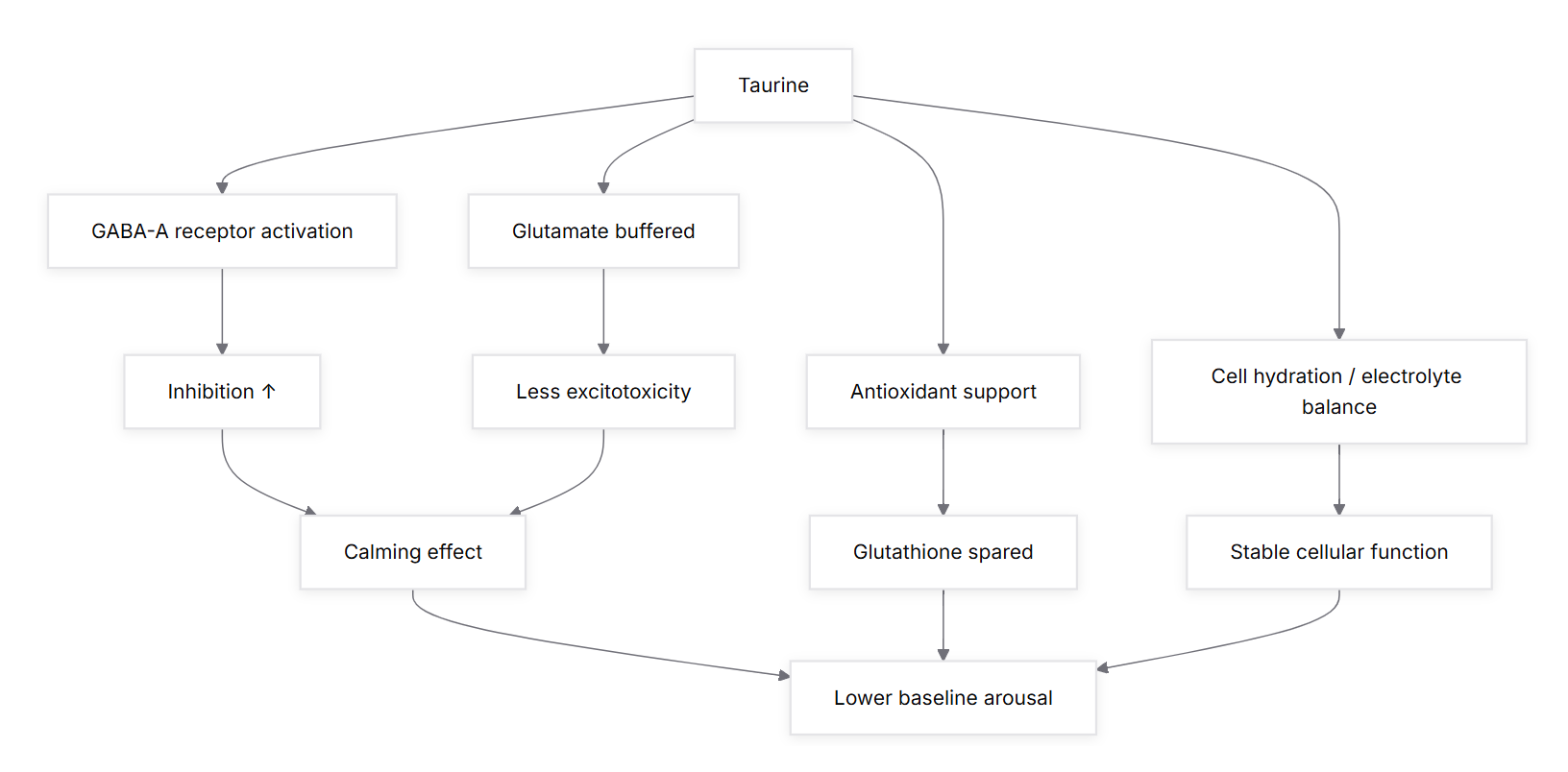
Taurine
Taurine → GABA receptor support → Glutamate buffered → Calm without drowsiness
graph TD
    A[Taurine] --> B[GABA-A receptor activation]
    B --> C[Inhibition ↑]
    A --> D[Glutamate buffered]
    D --> E[Less excitotoxicity]
    A --> F[Cell hydration / electrolyte balance]
    C --> G[Calming effect]
    E --> G
    A --> H[Antioxidant support]
    H --> I[Glutathione spared]
    F --> J[Stable cellular function]
    G --> K[Lower baseline arousal]
    I --> K
    J --> K
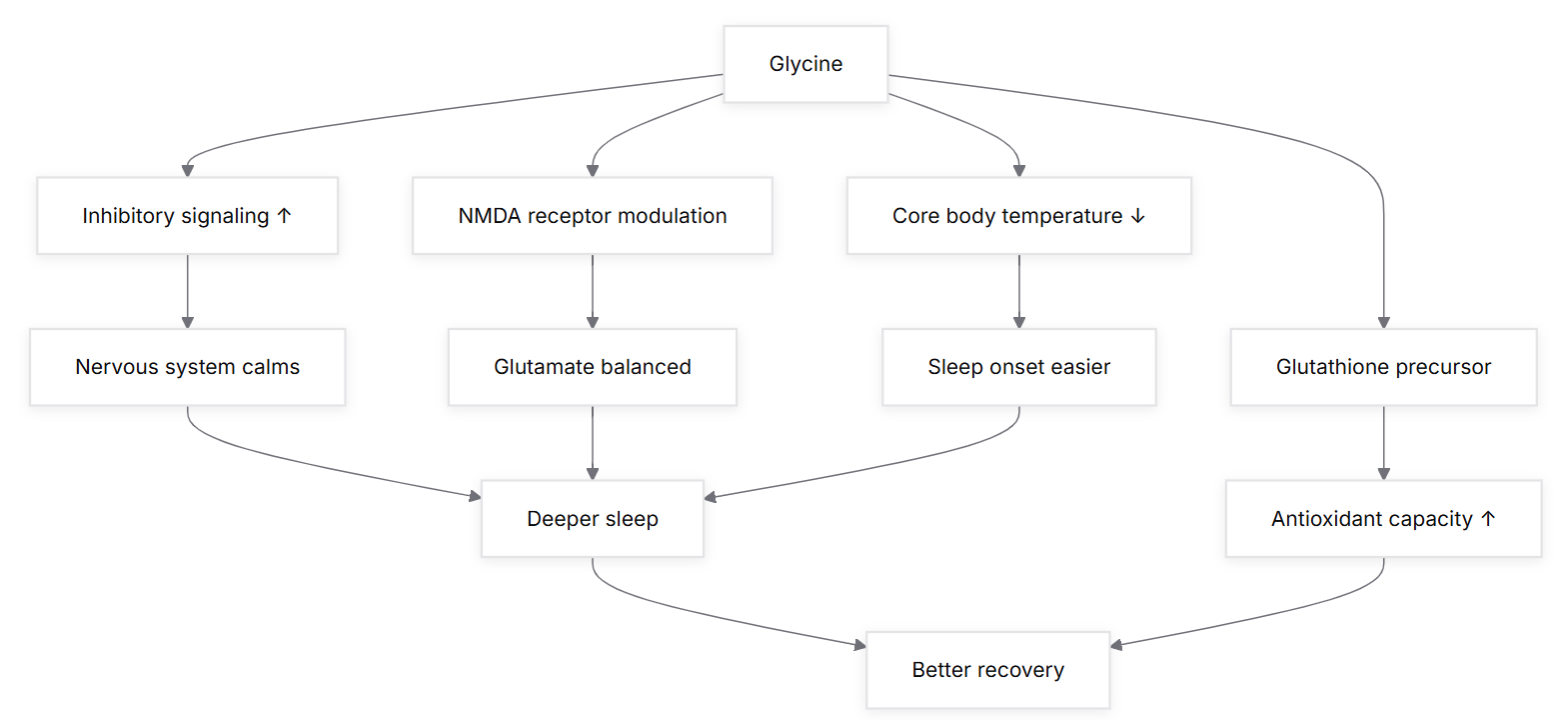
Glycine
Glycine → Inhibitory neurotransmitter → GABA partner → Deeper sleep, calmer nervous system
Glycine is a quieter brake than GABA, works well for nighttime. Bonus: it is one of three amino acids needed to make glutathione, so it supports recovery capacity too.
graph TD
    A[Glycine] --> B[Inhibitory signaling ↑]
    B --> C[Nervous system calms]
    A --> D[NMDA receptor modulation]
    D --> E[Glutamate balanced]
    A --> F[Core body temperature ↓]
    F --> G[Sleep onset easier]
    C --> H[Deeper sleep]
    E --> H
    G --> H
    A --> I[Glutathione precursor]
    I --> J[Antioxidant capacity ↑]
    H --> K[Better recovery]
    J --> K
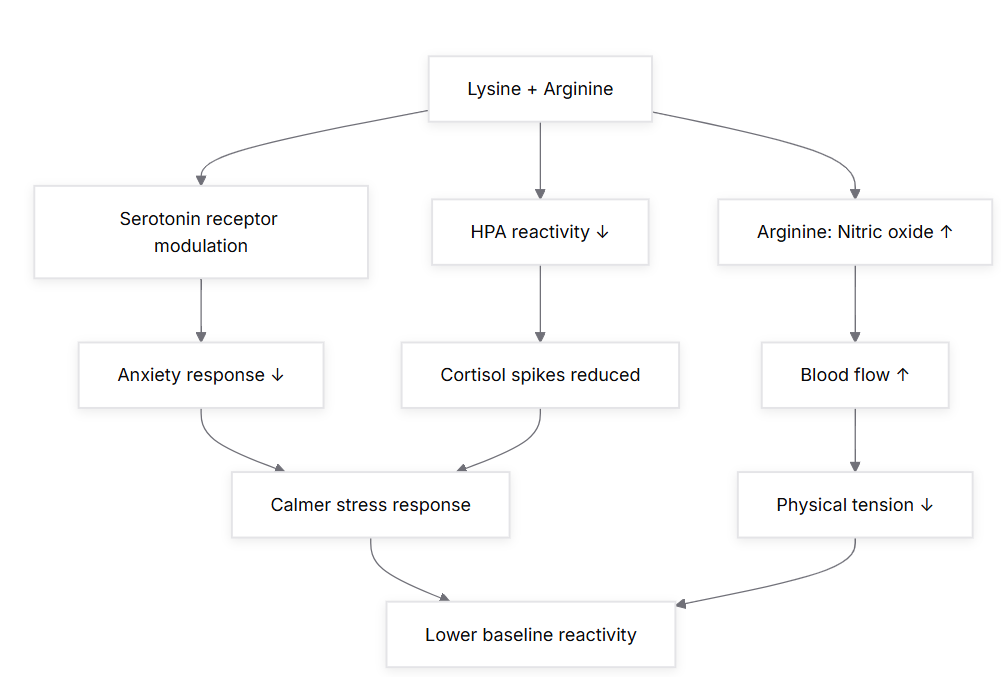
Lysine (+ Arginine)
Lysine + Arginine → Serotonin receptor modulation → Cortisol response ↓ → Lower anxiety reactivity
Lysine alone blocks stress-induced anxiety via serotonin receptors, arginine alone supports blood flow and can lower blood pressure; together they reduce HPA reactivity more than either alone.
This combo targets the stress response system directly rather than GABA/glutamate. Useful if your issue is overreactive cortisol spikes rather than pure excitation.
graph TD
    A[Lysine + Arginine] --> B[Serotonin receptor modulation]
    B --> C[Anxiety response ↓]
    A --> D[HPA reactivity ↓]
    D --> E[Cortisol spikes reduced]
    C --> F[Calmer stress response]
    E --> F
    A --> G[Arginine: Nitric oxide ↑]
    G --> H[Blood flow ↑]
    H --> I[Physical tension ↓]
    F --> J[Lower baseline reactivity]
    I --> J
GABA
GABA supplement → Limited brain entry → Peripheral calming → Mild effect (if any)
Supporting your own GABA production and receptor function (magnesium, glycine, taurine) is more reliable than supplementing GABA directly.
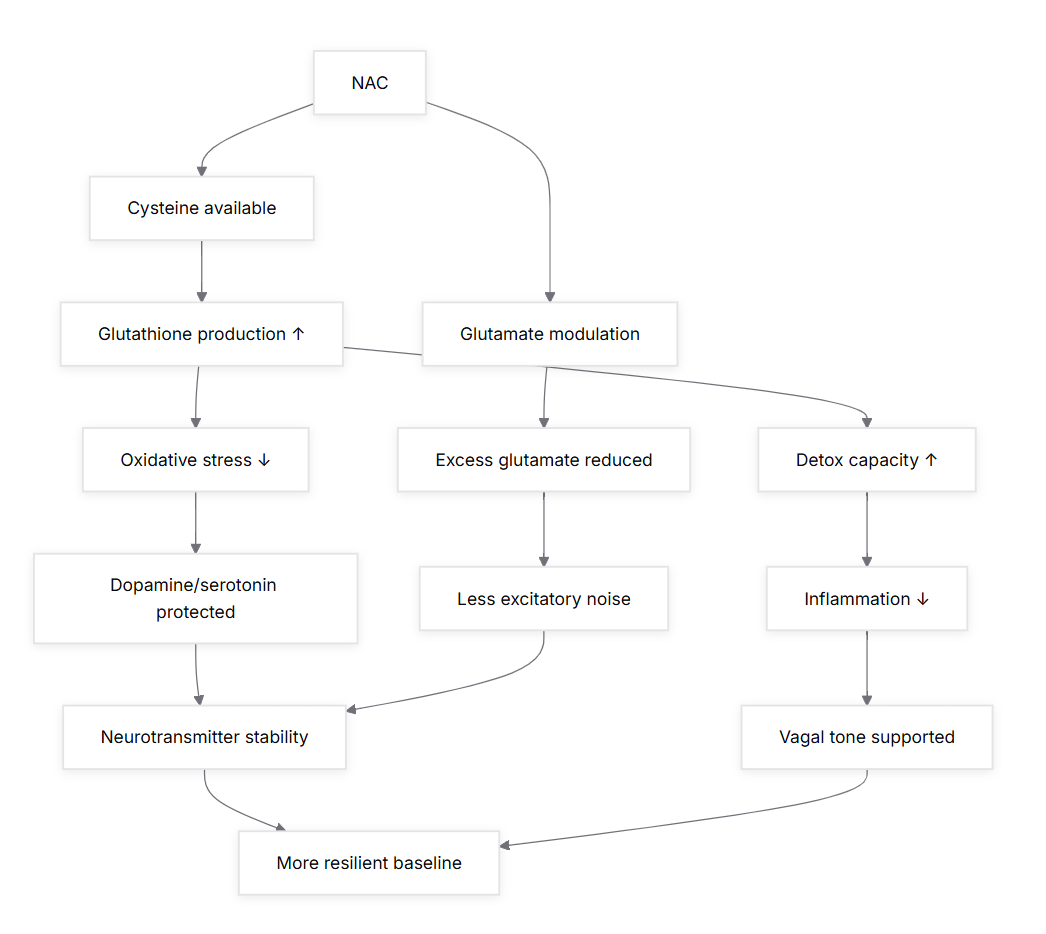
NAC
NAC → Glutathione precursor → Antioxidant capacity ↑ → Glutamate modulated → Better cleanup and recovery
graph TD
    A[NAC] --> B[Cysteine available]
    B --> C[Glutathione production ↑]
    C --> D[Oxidative stress ↓]
    D --> E[Dopamine/serotonin protected]
    A --> F[Glutamate modulation]
    F --> G[Excess glutamate reduced]
    G --> H[Less excitatory noise]
    E --> I[Neurotransmitter stability]
    H --> I
    C --> J[Detox capacity ↑]
    J --> K[Inflammation ↓]
    K --> L[Vagal tone supported]
    I --> M[More resilient baseline]
    L --> M
Omega-3
Omega-3 → Inflammation ↓ → Cell membranes healthier → Neurotransmitter signaling improved → BDNF ↑
Omega-3 is a slow-burn intervention. It does not calm you acutely, but over weeks it lowers baseline inflammation, improves receptor function, and supports the structural integrity of your brain. Foundation layer, not rescue layer.
graph TD
    A[Omega-3 / Fish oil] --> B[Inflammation ↓]
    B --> C[Microglia calmer]
    C --> D[Less glutamate release]
    A --> E[Cell membrane fluidity ↑]
    E --> F[Receptor function improves]
    F --> G[Dopamine/serotonin signaling ↑]
    B --> H[Vagal tone supported]
    H --> I[Anti-inflammatory brake works]
    A --> J[BDNF ↑]
    J --> K[Neuroplasticity supported]
    D --> L[Cleaner signaling]
    G --> L
    I --> L
    K --> M[Long-term resilience]
    L --> M
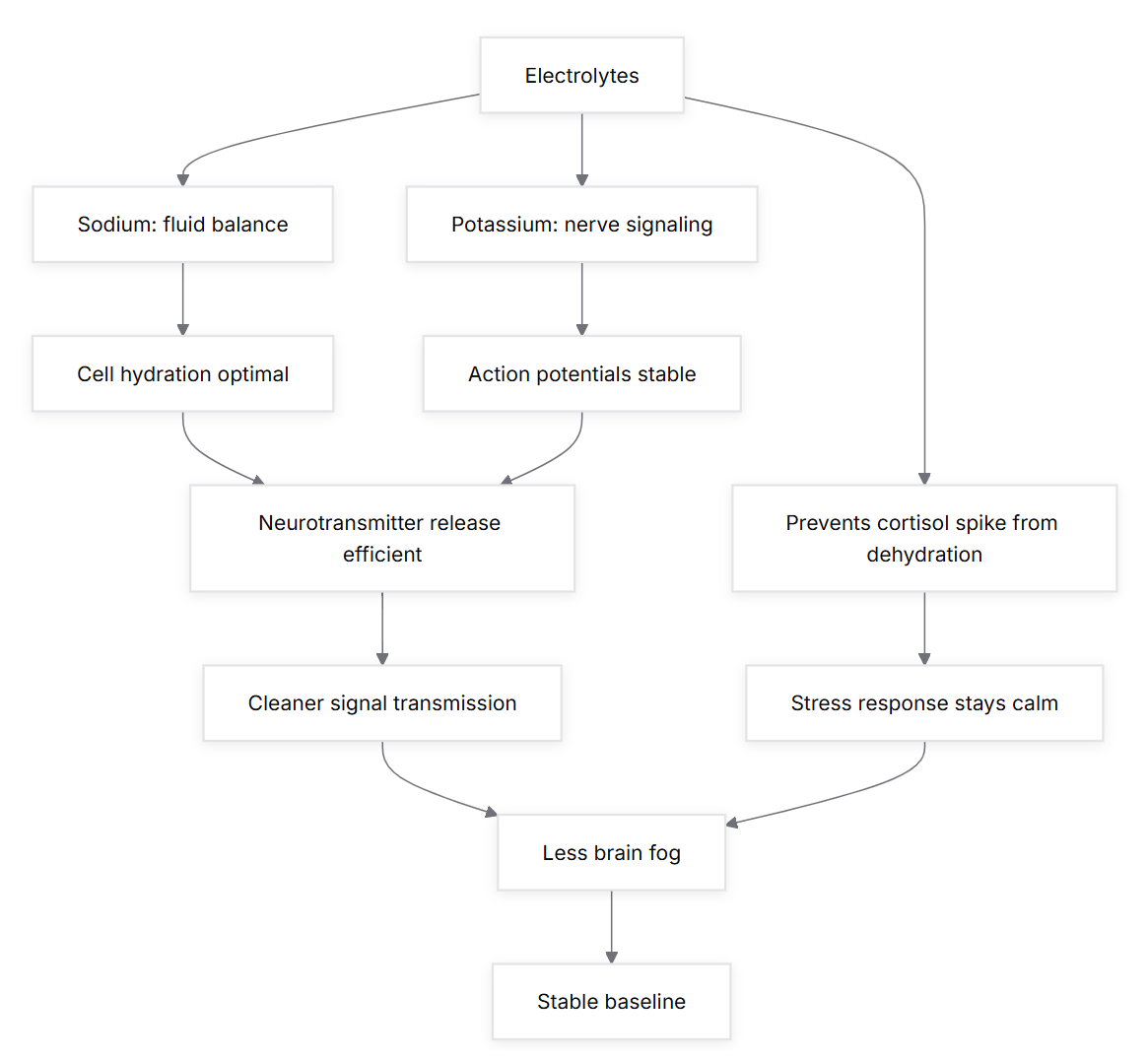
Non-Magnesium Electrolytes (Sodium & Potassium)
Electrolytes → Cell signaling ↑ → Neurotransmitter function ↑ → Stable energy, clearer cognition
graph TD
    A[Electrolytes] --> B[Sodium: fluid balance]
    B --> C[Cell hydration optimal]
    A --> D[Potassium: nerve signaling]
    D --> E[Action potentials stable]
    C --> F[Neurotransmitter release efficient]
    E --> F
    F --> G[Cleaner signal transmission]
    A --> H[Prevents cortisol spike from dehydration]
    H --> I[Stress response stays calm]
    G --> J[Less brain fog]
    I --> J
    J --> K[Stable baseline]
Visual Index
Here are the original diagrams for reference.
Social Overstimulation

Sensory Overload
High-Gain Induced Anxiety
Anxiety Triggers
Depression
Exercise - HIIT
Exercise - Zone 2
Exercise - Strength
Exercise - Chronic Effects
Stress and Deadlines
Inflammation
Sleep
Breathing

Morning Light Exposure
Daydream mental recovery

Hydration

Caffeine
Sugar and Carbs
Protein
Alcohol
Histamine
Magnesium
L-Theanine
Taurine
Glycine
Lysine
NAC
Omega-3

Electrolytes